
 EN
EN


In modern fabrication and construction supply chains, dimensional accuracy is not a preference — it is a requirement. steel bar processing equipment plays a central role in achieving that requirement by controlling every stage of cutting, bending, and forming with engineered precision. When tolerances are tight and project schedules are demanding, the machinery used to shape steel bars directly determines whether output meets specification or creates costly rework.
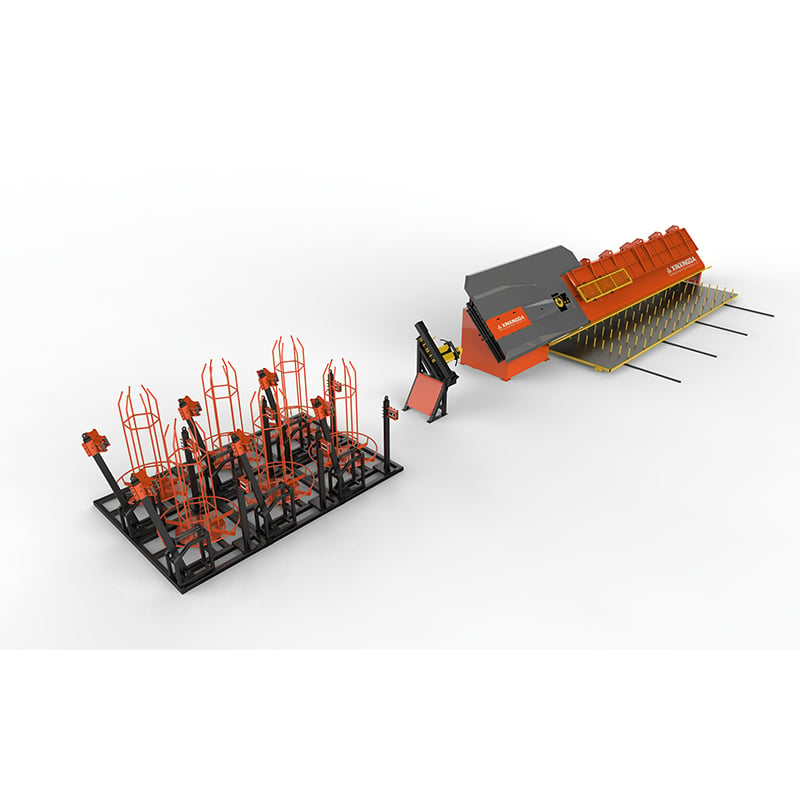
Steel bar processing equipment has advanced significantly in recent years, moving from manually operated machines toward highly automated systems with programmable controls and real-time feedback mechanisms. This evolution is not cosmetic. It reflects a genuine shift in how fabrication facilities approach quality assurance — embedding accuracy at the machine level rather than relying solely on post-production inspection. Understanding how this equipment improves production accuracy requires a close look at its core mechanisms, workflow integration, and measurable operational benefits.
Precision Control Mechanisms in Steel Bar Processing Equipment
Servo-Driven Motion and Dimensional Repeatability
One of the most significant contributors to improved accuracy in steel bar processing equipment is servo-driven motion control. Unlike older hydraulic or manual systems, servo motors respond to precise electrical signals that translate directly into controlled physical movement. This means that when a bending angle or cut length is programmed, the machine executes it with minimal deviation across hundreds or thousands of repetitions. For fabricators producing large volumes of identically dimensioned parts, this repeatability is foundational to consistent quality.
Steel bar processing equipment using servo technology can hold dimensional tolerances that manual or semi-automated machines cannot reliably achieve. Even minor inconsistencies in bend radius or cut length accumulate across a production run and create assembly problems downstream. By anchoring each operation to servo-controlled movement, the equipment removes the variability that human adjustment introduces and replaces it with programmable, verifiable precision.
CNC Programming and Parameter Storage
CNC integration allows operators of steel bar processing equipment to input exact specifications — including bar length, bend angle, bend sequence, and quantity — and have those parameters stored as repeatable programs. When the same part type is needed again, the stored program is recalled and executed without re-entering values or recalibrating the machine. This eliminates setup errors, which are among the most common sources of dimensional inaccuracy in fabrication environments. Steel bar processing equipment with robust CNC capability effectively transfers quality control responsibility from individual operator skill to verified digital programming.
Workflow Integration and Error Reduction
Automated Feeding and Positioning Systems
Accuracy in steel bar processing equipment is not limited to the bending or cutting action itself. Feeding and positioning systems are equally critical. If a bar is not held and advanced at a precisely controlled rate, even a well-calibrated bending head will produce off-spec results. Automated feeders integrated into steel bar processing equipment maintain consistent bar positioning throughout each cycle, preventing the micro-shifts that cause angular or length errors. The result is a stable material path that supports accurate output at every step.
Steel bar processing equipment that combines automated feeding with programmable stops and sensors creates a closed-loop positioning system. The sensor confirms bar position before each operation is executed, and any deviation outside an acceptable range triggers a hold or alert rather than allowing a non-conforming piece to be produced. This kind of in-process verification is a meaningful upgrade over inspection-only quality models.
Reduction of Manual Handling and Operator Variability
Manual intervention at any stage of a production process introduces variability. Steel bar processing equipment designed to minimize manual handling therefore directly improves accuracy by reducing the number of points at which human error can enter the workflow. Automatic clamping, guided bar travel, and programmed operation sequences mean that the operator role shifts from physical manipulation to program monitoring. This change is particularly valuable in high-volume environments where fatigue and repetitive task degradation would otherwise affect output quality across extended production shifts.
Operational Benefits That Support Long-Term Accuracy
Consistency Across Batches and Operators
A major challenge in fabrication facilities is maintaining the same accuracy level when different operators run the same steel bar processing equipment on different shifts or production runs. With manual machines, output quality varies with operator experience and attention. With programmed steel bar processing equipment, the stored parameters deliver the same result regardless of who initiates the cycle. This batch-to-batch consistency is critical for contractors and fabricators who supply pre-processed bars to construction or manufacturing projects with zero-tolerance assembly requirements.
Steel bar processing equipment that supports multi-user program libraries also allows engineering teams to standardize part specifications across facilities or shifts. Rather than each operator interpreting a drawing and setting up a machine independently, approved programs are shared and applied uniformly. The accuracy lives in the program, not in any individual's interpretation, making quality more predictable and auditable.
Reduced Scrap and Rework Rates
Every non-conforming piece produced by steel bar processing equipment represents wasted material and lost time. High scrap rates are often a symptom of equipment that cannot hold tolerances reliably. Modern steel bar processing equipment addresses this directly by improving first-pass yield — the proportion of output that meets specification without correction. When steel bar processing equipment produces accurate results consistently, scrap rates fall, rework time is eliminated, and throughput increases. These are not marginal improvements; in high-volume production, even a small percentage improvement in first-pass yield generates significant material and labor savings.
FAQ
What types of operations does steel bar processing equipment typically perform?
Steel bar processing equipment typically performs cutting to length, bending to specified angles, and in some configurations, stirrup forming and multi-bend sequencing. Advanced all-in-one models integrate these functions so that a single machine can complete a full part without manual transfer between stations, which further supports dimensional accuracy and efficiency.
How does steel bar processing equipment handle different bar diameters accurately?
Most steel bar processing equipment is designed to handle a specified range of bar diameters, with programmable or adjustable tooling settings that account for diameter-specific springback and material behavior. CNC-controlled systems allow operators to input the bar diameter as a parameter so that the machine automatically compensates and delivers the correct finished angle or length for each size within its rated range.
Is steel bar processing equipment suitable for small-volume custom fabrication as well as mass production?
Yes. Steel bar processing equipment with programmable controls is well suited to both scenarios. For custom fabrication, the ability to quickly program and switch between different part specifications reduces setup time and makes short runs economically viable. For mass production, the repeatability and speed of automated steel bar processing equipment ensure high throughput without sacrificing accuracy, making it a flexible investment across a range of production scales.