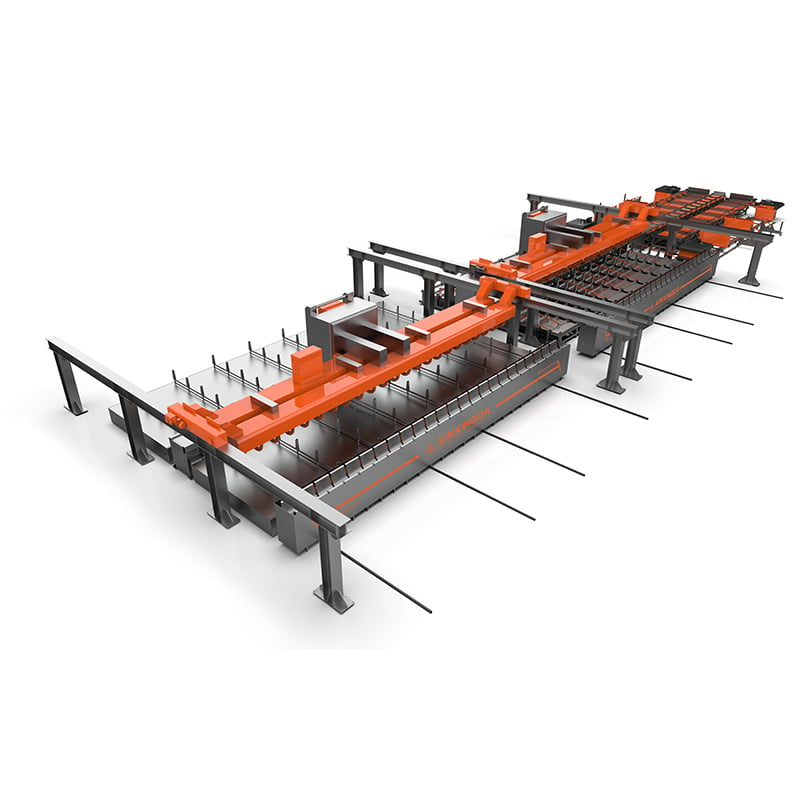
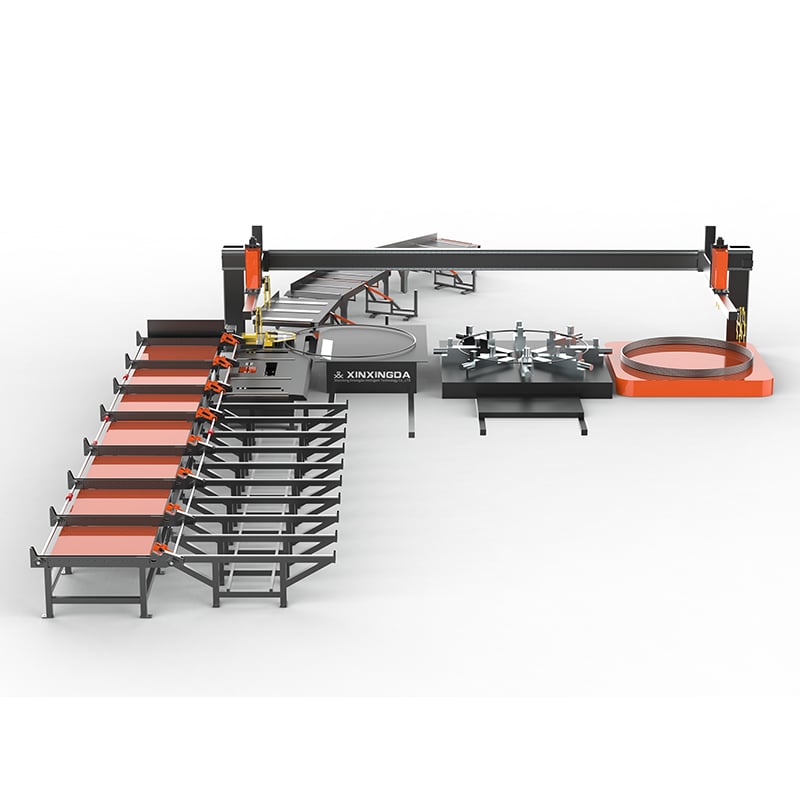
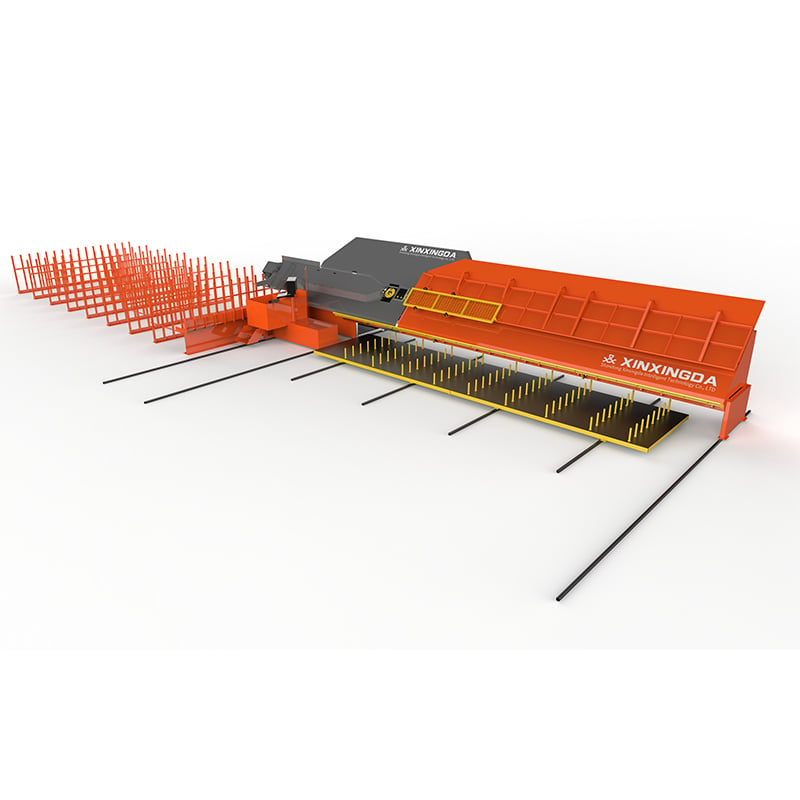
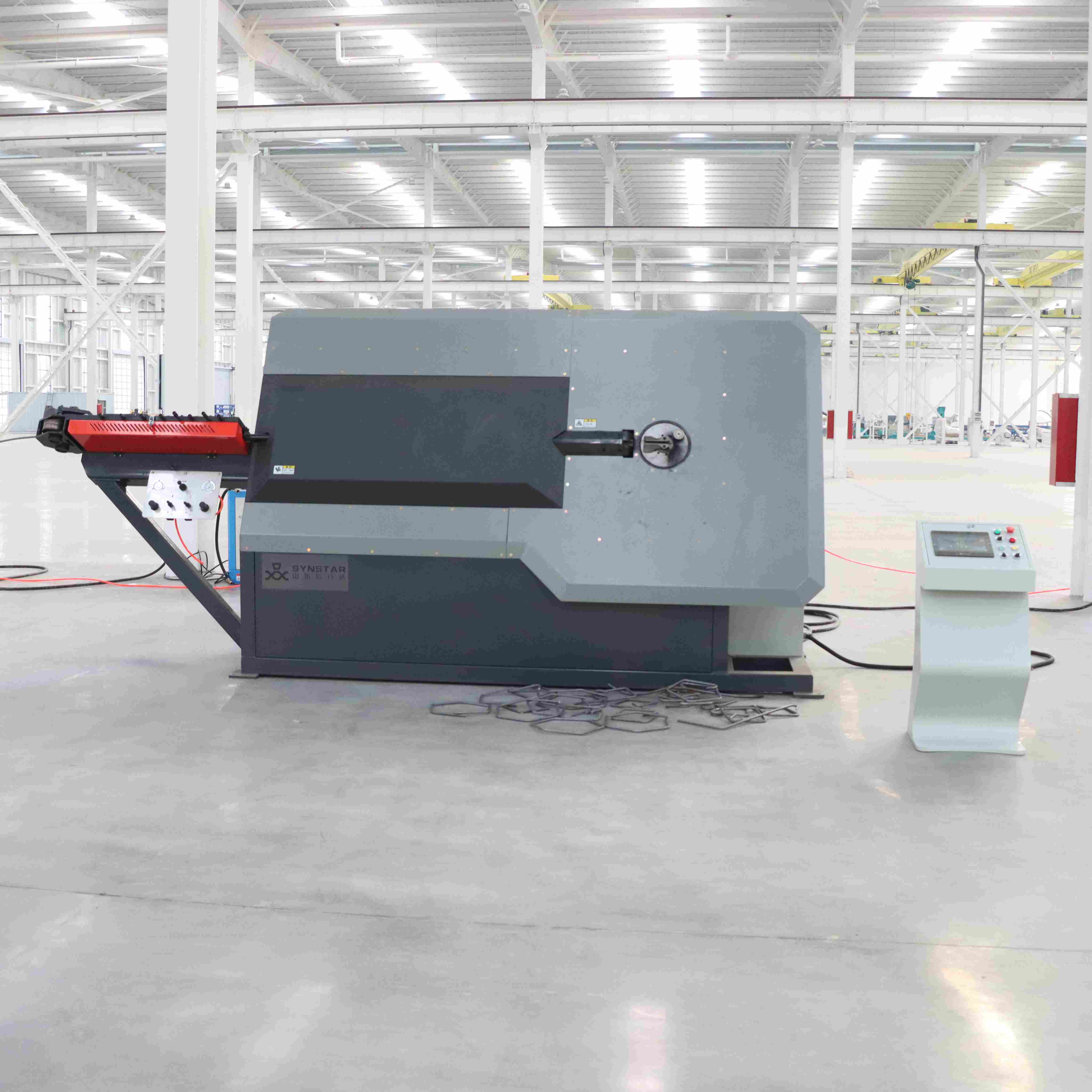
In the steel bar processing industry, steel bar hoop bending machines are by no means novel equipment. However, there are still very few operators who can correctly utilize such equipment and achieve high processing efficiency. Many construction sites are equipped with automatic CNC hoop bending machines, yet their processing efficiency still remains at the level of semi-automatic equipment, which is mainly caused by incorrect operation, inadequate adjustment and backward maintenance. To fully unlock the potential of a steel bar hoop bending machine, the core lies in five key aspects: preparation, adjustment, maintenance, safety and optimization.
1. Pre-startup Preparation: The Foundation of Efficiency
The normal operation of a steel bar hoop bending machine starts before startup. Many operators rush to start the equipment immediately after arriving at the post, which leads to frequent jamming and repeated adjustments during operation, consequently wasting twice as much time in vain.
Before startup, operators must first check whether all mechanical conditions meet requirements, confirm that the operating table and the workbench of the hoop bending machine remain horizontal, prepare all mandrels, tools and retaining parts, and complete all preliminary preparations before startup. According to the diameter of the steel bar to be processed and the requirements of the hoop bending machine, install the mandrel, forming shaft, retaining shaft or variable retaining frame. A key parameter worth noting here is that the diameter of the mandrel should be 2.5 times the diameter of the steel bar. If an incorrect mandrel is selected, the finished main bars will either have unacceptable slope deviation, or the equipment will be directly damaged, making rework inevitable and impairing processing efficiency.
In addition, before daily startup, operators must check whether the mandrel, retaining block and turntable are damaged or cracked, and whether the protective cover is firmly fixed. Only after confirming normal operation through idling can formal operation start. This few-minute inspection guarantees two hours of subsequent safe operation, so this time investment is absolutely worthwhile.
For pneumatic hoop bending machines, the pressure value needs to be adjusted in advance: a lower pressure can be set for thin steel bars, while a higher air pressure is required for thick steel bars or threaded steel bars, and a value around 4.0 is generally adopted. After connecting the three-phase power correctly and preparing 46# gear oil, startup can be performed only when all preparations are completed. This practice enables subsequent operations to be completed in one go and greatly reduces the probability of unplanned shutdown during operation.
2. Accurate Adjustment: The Core of Efficiency
Whether a steel bar hoop bending machine can achieve high efficiency is almost entirely determined by the adjustment stage. More specifically, normal efficient operation depends on three accurate adjustment operations:
First, accurate control of steel bar straightening. This is the prerequisite for continuous operation of the hoop bending machine. Operators need to thread the steel bar into the rollers of the steel bar straightener, toggle the power switch of the steel bar straightener to the inching position, adjust the spindle to make the first two horizontal wheels and the first three vertical wheels press down so that the steel bar is in a curved state, and make the remaining vertical wheels press down to keep the steel bar in a straight state, then start the forward button of the steel bar straightener to check whether the steel bar is straightened. Some operators cut corners by adjusting the tightness of the pressure roller directly at the beginning, which leads to steel bar deviation and large error in hoop bending size, and repeated readjustment wastes a lot of time. In fact, adjusting the spindle according to the actual state of different coiled steel bars can achieve one-time qualified adjustment and ensure that the straightened steel bar can pass through the hoop bending mechanism smoothly.
Second, intelligent application of basic parameters. Current high-quality CNC hoop bending machines are equipped with powerful PLC control and automatic compensation algorithms. By reasonably adjusting processing parameters such as bending speed, feeding speed and cutting length in the control system according to different materials and specifications of steel bars, processing efficiency and finished product qualification rate can be greatly improved. In actual production, many hoop bending machines only require one operator, who completes the setting and reading of process parameters through a touch screen. Common specifications of main bars, angles and quantities can be pre-stored in the system in advance, and can be called up with one click during processing, which eliminates the time wasted on repeated manual parameter adjustment.
Third, detailed management of dimension detection and positioning. When adjusting each bending point according to the dimension requirements of main bars, operators need to loosen the connecting nut on the hoop bending component, rotate the gear with a special tool handle, and tighten the fixing bolt after moving each bending point to the predetermined position one by one to ensure firm fixation without loosening. After adjusting the first piece, it is recommended to bend a test piece first, and start mass processing only after confirming that the dimension and angle are qualified, so as to avoid mass rework.
3. Standardized Operation: Balancing Efficiency and Safety
High efficiency is not achieved by overexertion, but based on standardized operation procedures. Experienced operators who are proficient in hoop bending machines all understand that following operating procedures is the only way to achieve steady speed improvement.
When the hoop bending machine is in operation, insert the straight end of the steel bar into the gap provided by the fixed configuration of the turntable, make the other end close to the fuselage fixed baffle and clamp it by hand, confirm that the fuselage is indeed installed on the side blocking the steel bar before starting. During operation, it is forbidden to replace the mandrel, change the angle, change the speed, refuel, clean the site or touch the moving mechanical parts. These behaviors will cause dimension error and material jamming in minor cases, and lead to work safety accidents in severe cases.
During steel bar processing, it is forbidden to process steel bars exceeding the specified diameter, quantity and mechanical speed of the equipment. A hoop bending machine has its own performance limits. Overload operation will not only damage the equipment and cause unplanned shutdown, but also reduce the operation efficiency to zero instantly, which is not worth the gain. Within the working radius of the bending steel bar and on the non-fixed side of the fuselage, no personnel is allowed to stay. Finished semi-finished products shall be stacked neatly, and bending hooks shall not face upward. Orderly stacking of finished products also saves time for material retrieval in the next process.
4. Mature Tips: Converting Small Skills into Greater Efficiency
To maximize the efficiency of a steel bar hoop bending machine, some mature skills can often achieve extraordinary effects with minimal effort.
Mass processing skills. When a large number of steel bars need to be processed, a mass setting strategy can be adopted: input the quantity and shape parameters of required main bars at one time, and the equipment can automatically perform continuous processing and forming, which greatly reduces manual intervention. The processing speed of automatic hoop bending machines generally reaches 1800-2200 pieces per hour, and the integration of straightening and bending greatly saves the intermediate turnover time. Compared with the traditional manual process of the same type, the production efficiency of automatic processing equipment is generally 3 to 4 times that of manual processing.
Skill for improving measurement and fixed-length efficiency. Equipping a CNC hoop bending machine with a digital meter counting device can accurately control the feeding length of steel bars, with an error range within ±1 mm, which eliminates the trouble of repeated measurement and greatly improves processing accuracy. After correctly setting the dimensions and verifying through trial bending, uninterrupted mass processing enables the hoop bending machine to maintain the optimal continuous operation rhythm all the time.
Prioritizing safety ensures efficiency. Safety and high efficiency are two sides of the same coin, and safety operating procedures essentially underpin efficiency. Operators must receive professional training, be familiar with the structure, performance and operating procedures of the hoop bending machine, wear standardized work clothes and correct protective equipment such as safety helmets and goggles, and it is forbidden to work when fatigued or drunk. When manual adjustment or troubleshooting is required, the operation must be performed after the equipment is completely stopped. When reversing the turntable, the procedure of "forward rotation-stop-reverse rotation" must be followed, and it is forbidden to switch directly from forward rotation to reverse rotation. Only without the interference of safety accidents can the hoop bending machine maintain full-load stable production.
5. Preventive Maintenance: Enabling Sustained High Efficiency of Equipment
Another guarantee for high-efficiency processing is continuous and comprehensive maintenance.
Preventive maintenance eliminates faults before they occur. After daily operation, it is necessary to clean the dust and oil on the surface of the equipment, check the connection of each component, and add lubricating oil to the transmission parts. The operation status of the transmission device, hydraulic device and electrical control system shall be checked regularly, and damaged components shall be replaced in time to ensure that the system is always in the best condition. Daily maintenance of key equipment is committed to "preventing problems before they occur" and avoiding the interruption of continuous production caused by sudden faults.
Practical methods for rapid troubleshooting. Even if sufficient preventive work is completed, hoop bending machines will inevitably encounter some small faults during daily operation, so operators need to have the ability to quickly troubleshoot. For example, when the hoop bending machine cannot start, first check whether the power supply is sufficient, and then check whether the cable connection is intact and free of looseness or damage. When inaccurate hoop bending occurs, check whether the bending die is assembled correctly and damaged, and adjust the bending angle and bending speed accordingly. When the hoop bending machine produces abnormal noise or vibration, check whether the base is fixed firmly and whether the gears and belts of the transmission device are loose, and lubricate key parts to reduce friction. For the problem of low working efficiency, first check whether the bending mechanism has abnormal noise or excessive friction resistance, then adjust the parameters targeted, and cooperate with regular cleaning and maintenance.
Conclusion
The efficiency of a single steel bar hoop bending machine varies greatly depending on the operator. The core difference lies in whether the principle that "good preparation precedes good work" is truly implemented. From careful preparation before startup, to accurate parameter adjustment, to scientific and standardized operating habits, and finally supplemented by detailed daily maintenance and necessary safety measures, when the whole set of procedures is implemented professionally, the efficiency of the hoop bending machine can increase steadily, and an efficient and safe construction environment will help operators confidently make progress and ensure quality in each project.
A steel bar hoop bending machine is a capable special tool. When used correctly, it is an accelerator for improving efficiency; when used incorrectly, it becomes a bottleneck and a safety hazard. It is hoped that this experience sharing can help every operator, and allow the steel bar hoop bending machine to become your most reliable partner on the construction site.
 Hot News
2026-05-27
2026-05-18
2026-05-12
2026-05-08
2026-05-01
2026-04-27
Copyright © 2026 Shandong synstar Intelligent Technology Co., Ltd. All rights reserved. - Privacy Policy
 EN
EN