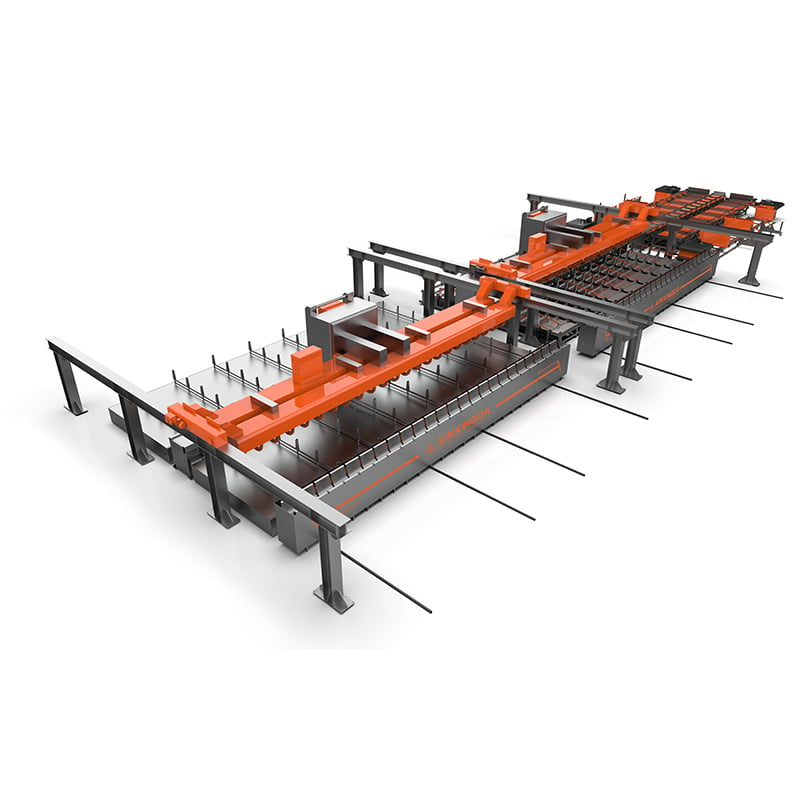
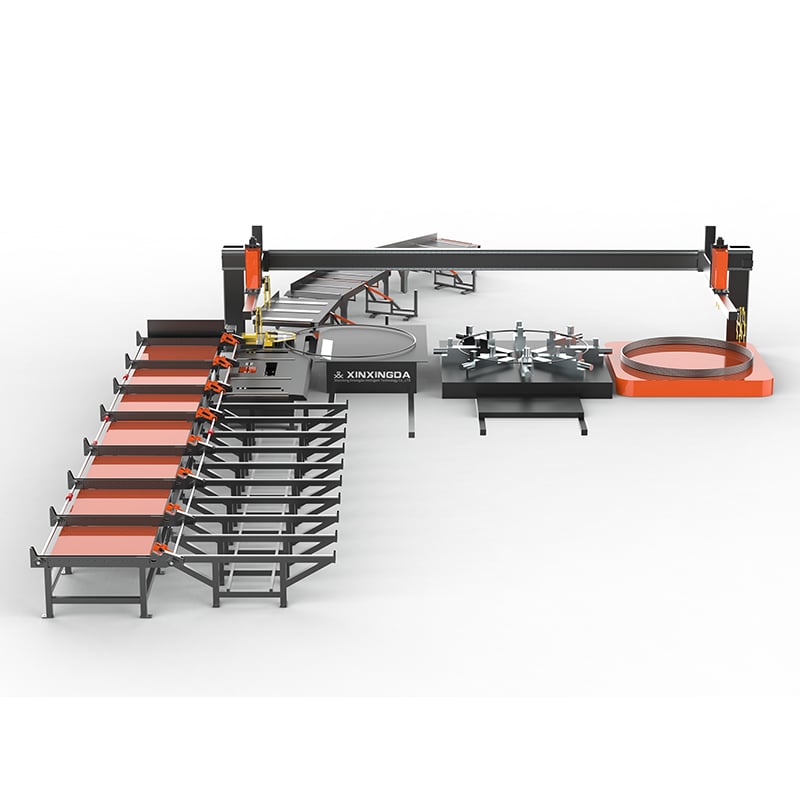
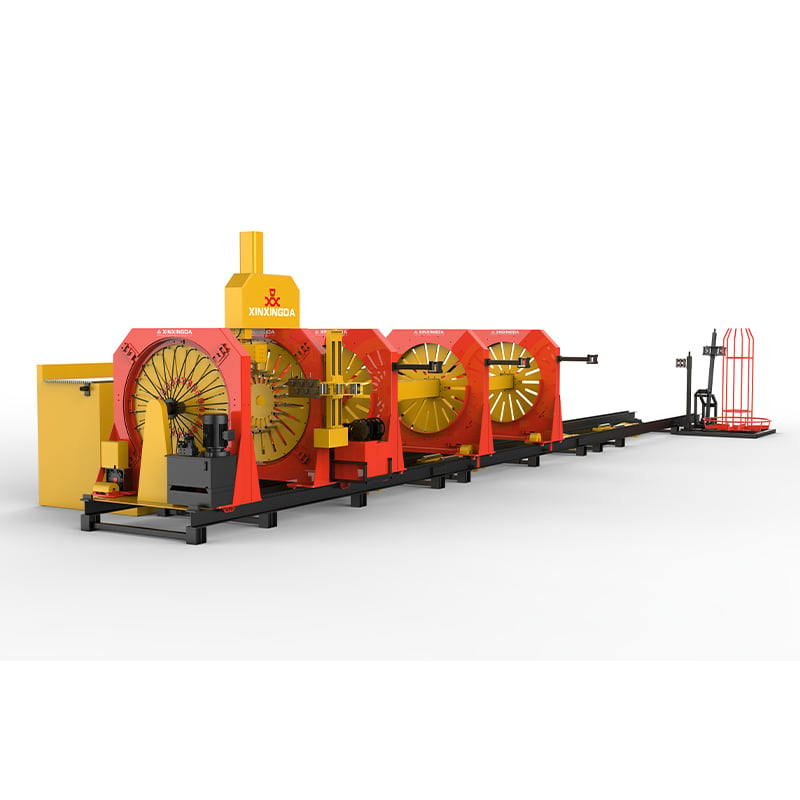
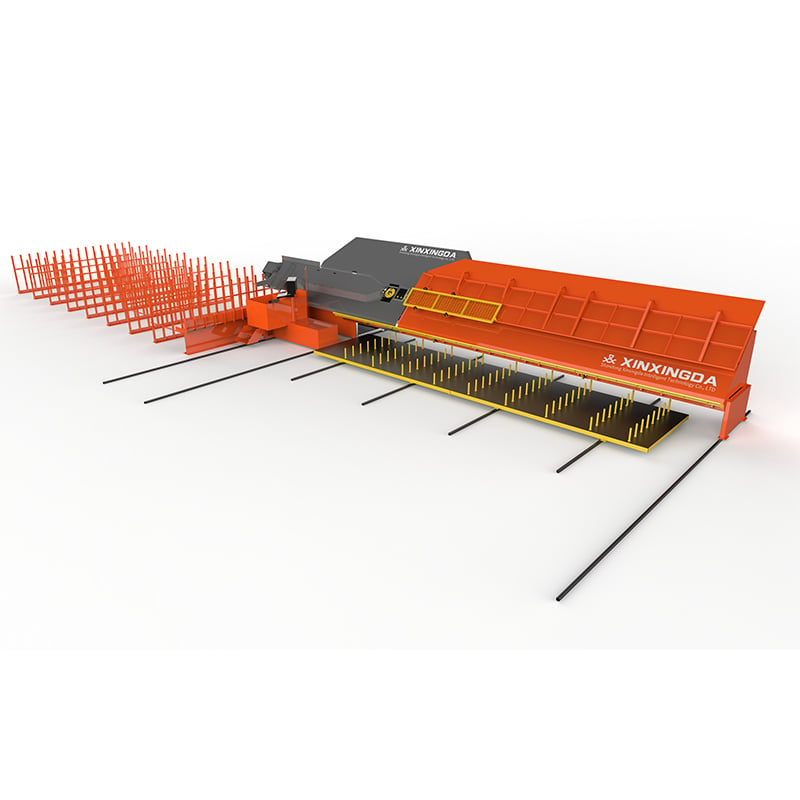
Under the backdrop of industrialized construction and intelligent building, the deep processing center for steel bars is transforming from the traditional "on-site cutting and manual binding" to "factory-based production and precise delivery". During this process, efficiency is not only about the output rate per unit volume, but also related to processing costs, the overall equipment effectiveness (OEE), the response time of freight logistics, and the level of data collaboration. It can be said that efficiency is the key for the deep processing center to transform from a "cost center" to a "profit center".
I. The Three-Dimensional Meaning of Efficiency
In traditional concepts, efficiency is often equated with "machine operation rate" or "average tonnage". However, in contemporary deep processing centers, efficiency should be structured into three levels:
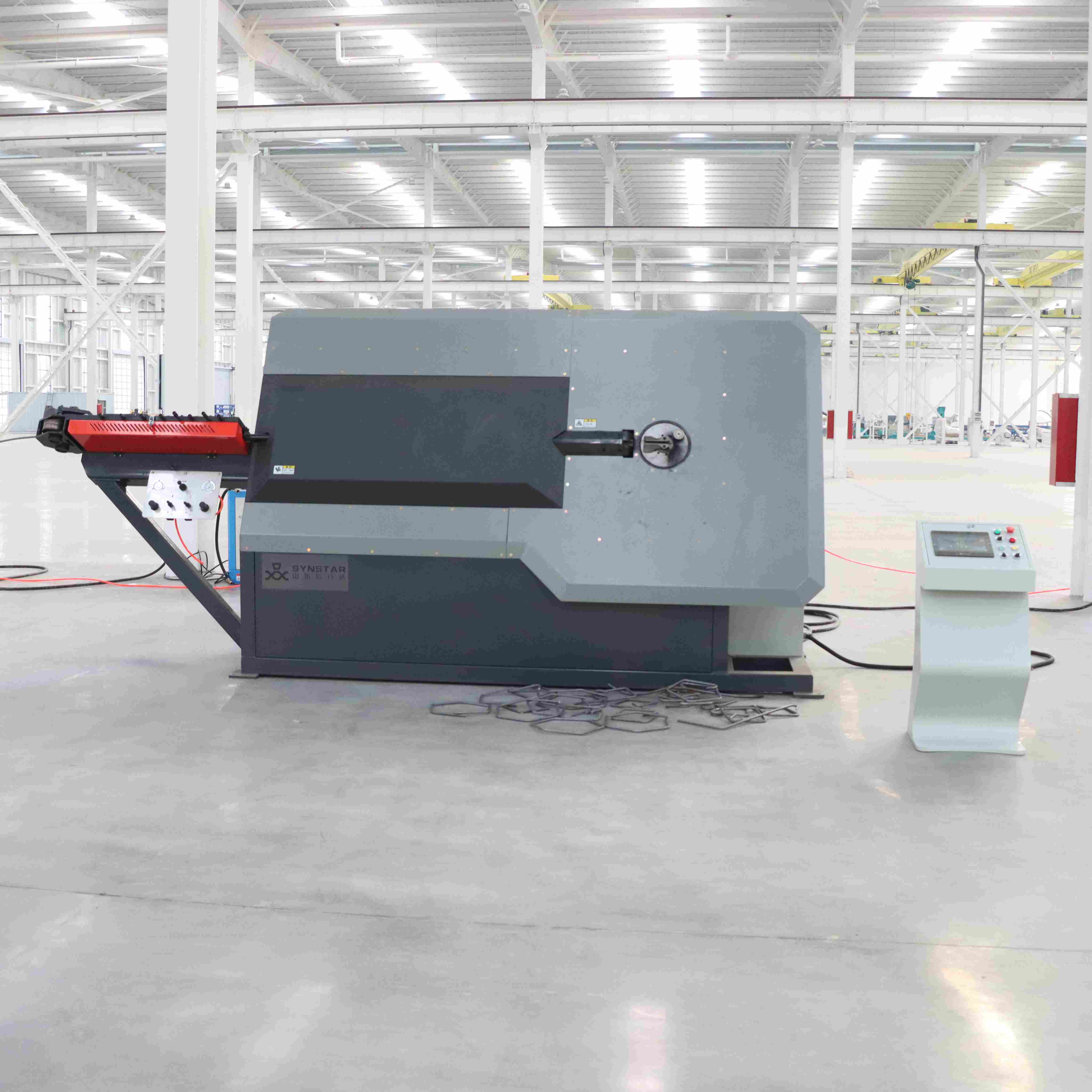
Machine equipment efficiency: The production line balance and mold changeover time of key processes such as steel bar bending, cutting, and threading. For instance, the use of a CNC steel bar bending machine can achieve an output rate of 15-20 main bars per minute, while traditional manual bending only reaches 5-8. The difference is obvious and vivid.
Raw material efficiency: The degree of match between the fixed-length of reinforcing bars and the processing drawing. According to the nesting optimization calculation method and the management method of edge and corner scraps, the utilization rate of reinforcing bars for pipe can be increased from 95% to over 98.5%. For a production and processing center with a capacity of tens of millions of tons, every 1% increase represents a substantial profit.
Fluidity efficiency: The total duration from the storage of raw materials, the processing and caching of semi-finished products to the shipment of finished products. Many central devices have a high utilization rate, but "raw materials are piled up like mountains and finished products are queued for shipment", which is a typical case of "high efficiency in parts but low efficiency overall".
Second, the three major obstacles to improving efficiency Even after the introduction of automated machinery, many deep processing centers still face the predicament of "fast machines and slow bottleneck steps":
The planning and scheduling have gone off track: The production processing forms on the construction site are in disarray (such as incorrect positive and negative values, and abnormal quantities), which requires manual checking one by one. This results in the production planner spending 3 to 4 hours each day just to sort out the mess, leaving less than an hour for actual scheduling improvement.
Time consumption for mold change and material clearance: When frequently changing specifications and models (such as from Φ12 to Φ25), the average time spent on calibrating the grinding tools and clearing residual short materials is 20 to 30 minutes. If the mold is changed 10 times a day, nearly 5 hours will be spent in a non-production state.
The logistics and information flow advertisements cannot be synchronized: AGV cars may either be parked while waiting for data signals or drag incorrect semi-finished products to the wrong processes. Once the paper material tags are damaged, the subsequent express sorting and distribution processes are like "the blind men touching an elephant".
Three. Four Practical Approaches to Enhance Efficiency Based on on-site investigations of several deep processing centers, the following four measures have the most direct practical effects:
First, establish a three-level planning system. Implement "locking weekly work plans, flipping daily plans, and hourly dispatching" in a hierarchical manner. Weekly work plans balance the order information of bulk commodities and the utilization of leftover materials; daily plans lock the equipment scheduling table with a granularity of 2 hours; hourly-level push the best processing sequence to the on-site terminal equipment for operators. After a certain production and processing center applied this system, the equipment material preparation time was reduced by 42%.
Second, implement SMED stamping automation. Transform the internal mold change posture (which must be done with the machine shut down) into an external posture (which can be fully prepared). For example, provide each mold with a standardized tooling cart. During mold change, the entire cart is sent in, precisely positioned and clamped, reducing the average mold change time to within 8 minutes.
Third, establish a "one order, one code" traceability system. Each production batch number is assigned a unique QR code label. Throughout the entire process from cutting, bending to packaging, the QR code is scanned for accounting. Operators no longer need to manually fill in production quantity forms, and senior management can view the progress of each order in real time. The response time for handling anomalies has been significantly reduced.
Fourth, introduce industrial Internet of Things and visual inspection systems. Deploy industrial cameras at a certain discharge port to instantly identify the quantity and structural dimensions of the products. Once a bending angle error exceeds ±1°, immediately trigger an alarm and adjust the key parameters to prevent large-scale waste. Currently, the cost of this approach has significantly decreased, making it feasible for small and medium-sized centers to implement.
Four. The ultimate orientation of efficiency: Service level must be deeply recognized: The ultimate goal of efficiency improvement in the deep processing center is not "to do faster and pile up more", but to support the on-time delivery at the construction site. The construction site will not praise you for bending 100 tons of main bars in a day, but will complain about you if the 50 tons of floor slab bars you need are 2 hours late. Therefore, when evaluating efficiency, two indicators, "on-time delivery rate" and "completeness rate", should be included - whether all the bars in the same beam are delivered on time simultaneously. If one is missing, the entire beam will be difficult to bind.
The efficiency of a steel bar deep processing center is an engineering project: it is standardized by the design data at the top, and at the bottom, it is rhythmized by the on-site bundling, with the equipment, logistics and staff in the middle working in harmony and resonance. Those managers who still consider efficiency as "the time after the machine starts up" are being quietly surpassed by their peers who define efficiency as "the total time from receiving the engineering drawings to the loading and unloading at the construction site". Only when each steel bar can be at the right time, in the right structure and in the right position, can the deep processing center truly unleash all its potential.
 Hot News
2026-05-27
2026-05-18
2026-05-12
2026-05-08
2026-05-01
2026-04-27
Copyright © 2026 Shandong synstar Intelligent Technology Co., Ltd. All rights reserved. - Privacy Policy
 EN
EN